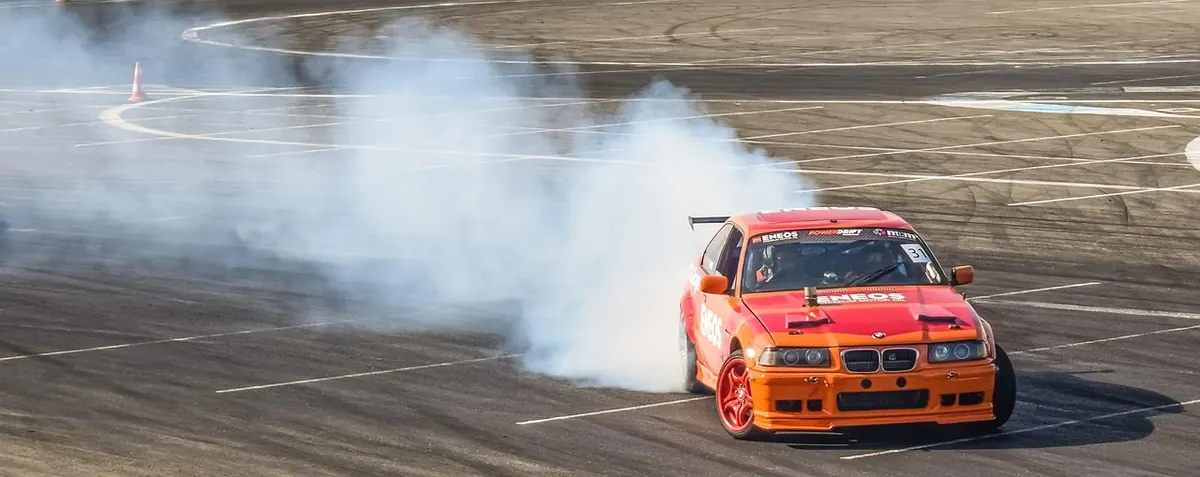
A clutch kick is the left foot's contribution to drifting, and it's the one that surprises people most. You're committed to a corner, throttle down, rear tyres working hard. Then you stab the clutch pedal for a fraction of a second and let it back up. The revs flare, the rear tyres break away, and the car rotates.
That's the whole trick. No handbrake, no lifting off, no dramatic steering — just a brief interruption in the drive to the wheels, and its sudden return. Done well, it's the smoothest way to start a slide at speed. Done badly, it's a spin, a missed corner, or another clutch on the shopping list.
What surprises people is how little you actually do. The steering angle is often already there. You've turned in, the car is loaded, the suspension is settled, the tyres are warm. The clutch kick doesn't create the slide so much as tip a car that was already on the edge. It's the smallest possible intervention applied at the moment the car is most sensitive to one.
What a Clutch Kick Actually Does
When you press the clutch, you disconnect the engine from the gearbox. The engine is suddenly free of the car's weight, so it spins up easily — that's the flare you see on the rev counter. The rear wheels, meanwhile, lose drive.
Release the pedal and it all comes back in one hit. The engine's momentum, plus the torque it was already making, arrives at the rear wheels as a step change rather than the smooth build-up the tyres were expecting. Rubber that was already near its limit lets go, and the back of the car steps out.
The important detail is that it's a spike, not a sustained push. The clutch is down only long enough to unload and reload the drivetrain, and short enough that you don't lose meaningful road speed. Hold the pedal in for a full second and you've simply stopped driving the car, which usually ends the slide rather than starting it.
There's a second effect worth understanding, too. When the clutch bites again, the revs have flared up — often several thousand rpm higher than they were. That means the engine is re-engaging closer to the middle of its powerband, where torque is strongest. So the kick delivers a sharper hit and a better-placed one, which is why it feels so much more decisive than simply pressing harder on the throttle.
Why it works on the limit
A clutch kick does very little in a straight line at low speed. It works because the rear tyres are already busy — cornering forces, acceleration, weight transfer — and the sudden torque spike is the last straw. The tyre only has so much grip to divide between turning and driving, and you've just asked the driven axle for a large chunk of it in an instant.
Load transfer matters here as well. Hard acceleration squats the rear, which on many cars takes camber and geometry away from the rear tyres just as you're demanding more from them. Add a bumpy surface, a cambered road, or a little too much speed into the corner entry, and the margin between a tidy slide and a spin is genuinely thin.
How to Do It: Step by Step
- Set the car up first. Turn in properly and hold steady throttle. You want the rear tyres loaded and the car settled before you ask for anything sudden.
- Keep the throttle where it is. This is the part people get wrong. You don't lift. Lifting transfers weight forward and adds rear grip — the opposite of what you want.
- Stab the clutch. A quick, sharp press with the left foot. Not a stomp to the floor and hold; think of it as a flick that lasts a fraction of a second.
- Release immediately. Let the pedal snap back up rather than easing it out. The abrupt return is the technique.
- Catch it with opposite lock. The moment the rear steps out, you should already be unwinding and counter-steering. If you wait to feel the slide before reacting, you're late.
- Stay on the throttle. Once the car is rotating, moderate throttle holds the slide. Coming off the power now will let the rear tyres hook up and snap the car straight — or the other way.
When a Clutch Kick Is the Right Tool
It isn't the answer to every corner. It suits certain situations better than others:
- Tight, slow corners where you need rotation but the car doesn't make enough power to break traction on throttle alone.
- Low-powered cars — a naturally aspirated four-cylinder often can't spin its tyres with throttle alone, but a clutch kick gives it the shock it needs.
- Fast entries where a handbrake pull would kill too much speed and look clumsy.
- Transitions when you're switching the car from one side to the other and want a clean, controllable break in the middle.
- Grip-limited surfaces — damp or dusty tarmac — where a small spike is all it takes.
Clutch Kick vs Handbrake vs Power-Over
Every initiation technique does the same job by different means, and the differences matter when you're choosing:
- Clutch kick: spikes torque to the rear wheels. Fast, elegant, keeps your hands on the wheel. Wears the clutch, and does nothing if the rear tyres already have plenty of grip to spare.
- Handbrake: locks the rear wheels entirely. Instant and dramatic, excellent for tight hairpins, but scrubs speed fast and can be hard to modulate smoothly. Requires a mechanical handbrake that can cope.
- Power-over: uses raw engine torque to overwhelm the rear tyres. Cheapest on components and the easiest to sustain, but needs power — and it's slower to build than a kick.
Experienced drivers often blend them. A clutch kick to start the rotation, throttle to hold it, and the handbrake only for the tightest hairpins where nothing else will do.
What It Costs You Mechanically
Honesty is required here: a clutch kick is a shock load through the whole drivetrain. Every one of those spikes takes a little life out of the friction disc, the release bearing, the gearbox mounts, the propshaft and the differential.
On a dedicated drift car with an uprated clutch, that's simply the cost of doing business. On your daily driver, a habit of clutch-kicking every roundabout will have you pricing a clutch kit well before you expected to. Flicking the pedal and letting it up cleanly is far kinder than riding the clutch halfway through a corner — a slipped clutch under load builds heat quickly, and heat is what kills friction material.
Rule of thumb: the shortest kick that starts the slide is the correct one. If you can hear the engine flare for more than a beat, you're holding it too long — and paying for it.
Common Mistakes
- Lifting off the throttle. Instantly adds rear grip and cancels the effect. Stay committed.
- Holding the clutch in. Kills drive, scrubs speed, and usually ends the slide. A kick, not a press.
- Being late on the steering. The counter-steer needs to begin as the rear steps out, not after.
- Doing it on a straight. With no cornering load on the tyres, there's nothing to destabilise. Nothing happens — or the car simply kicks sideways without direction.
- Too much speed for the corner. A clutch kick adds rotation, not grip. If you're already too hot, it just accelerates the accident.
Practising Safely
Find a large, empty, private area — a skidpan, an airfield, or a dedicated drift day. Wet or damp tarmac is ideal to learn on: grip is lower, speeds are lower, and the consequences of getting it wrong are proportionally smaller.
Start with a figure of eight at moderate speed. Get used to turning in and holding steady throttle before you ever touch the clutch. Then add the kick, one corner at a time, and pay attention to how little pedal travel you actually need. Most drivers use far too much for far too long at first.
Once you can start a slide with a flick of the left foot and catch it without thinking, you've added the most versatile tool in the drift repertoire — the one that works when the handbrake is too brutal and the throttle isn't quite enough.